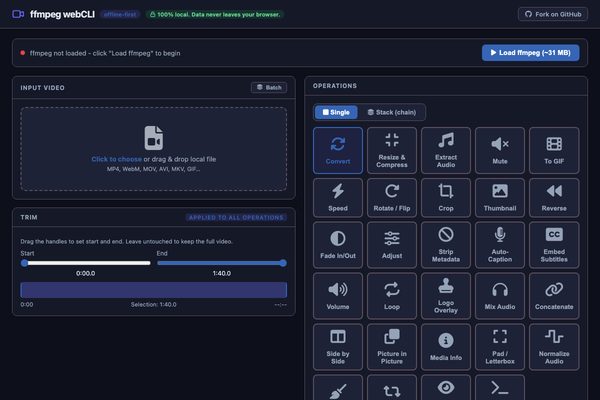
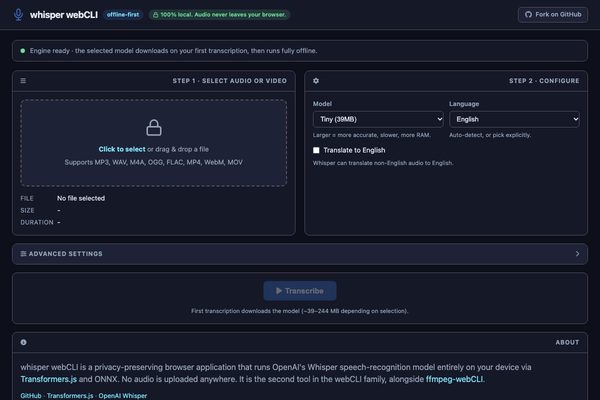
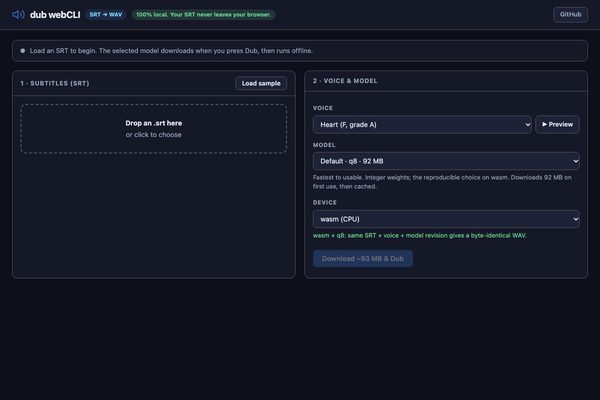
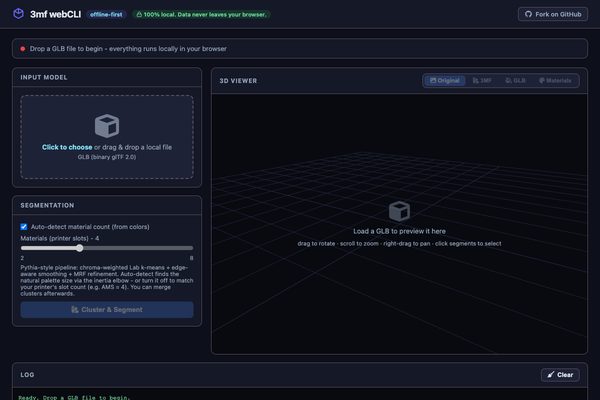
A family of browser tools that take a URL or a file and return an artifact, with your content processed on your device and no account; the paper explains the architecture. Loading code and models, and publishing to a repository, are the two declared exceptions below.
GET-only for loading. Input URLs, code and models are fetched with GET requests.
On-device processing. Your content stays on your device unless you explicitly publish it.
No account to process a file. Publishing tools require access to your repository.
Zero-egress is about your content, not about downloading the application. Each card declares what the tool fetches; hls and blog also publish to a repository when you ask them to.
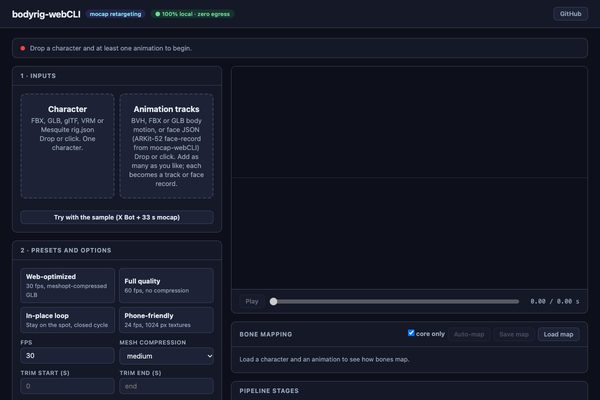
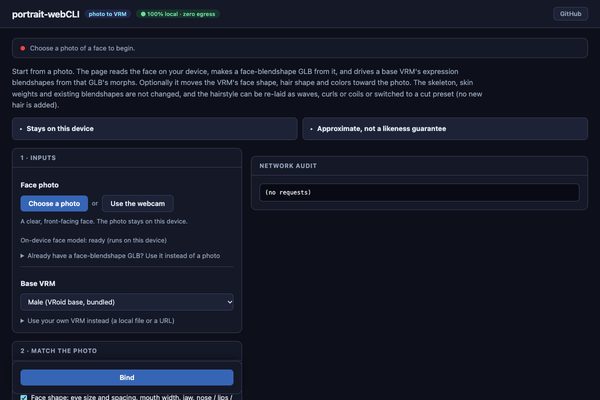
Implemented today by rig, look, portrait (3 of 12 tools). The other tools do not have it yet.
run= in the URL starts the operation where supported.
window.__webcli_result holds the result: { ok, op, artifact, error, meta }.
[data-webcli-status] on the body reports idle, loading, running, done or error.
Stable test ids for each tool are listed on its card.
// wait for the operation to finish, then read the handle
await page.waitForSelector('body[data-webcli-status=done], body[data-webcli-status=error]');
const result = await page.evaluate(() => window.__webcli_result);
a versioned adaptive-streaming release (ladder, segments, playlists) committed and tagged name/vN
not
ffmpeg, which does general transforms and keeps nothing; this one does exactly one thing
egress
user-initiated
fetches
not audited yet
repro
not verified
Publishing is a commit to your repository, so it is egress, and it is yours to start. H.264 only; variable-frame-rate and rotated files are refused by name.
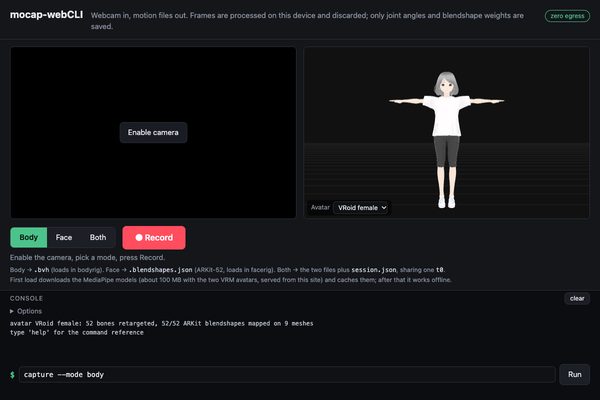
body motion as a BVH and face motion as ARKit blendshapes JSON
not
rig, which retargets motion onto a character you bring; this one only records, and bakes only onto its two bundled avatars
egress
none: your content stays on the device
fetches
nothing
repro
not verified
The source repository is private, so there is no open licence yet. One webcam cannot give studio-grade face and body at once. First load is about 100 MB.
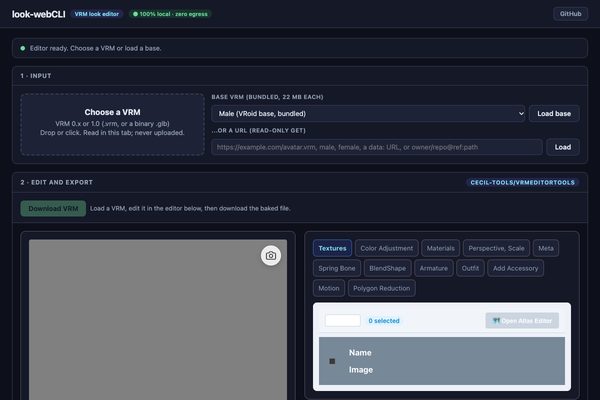
vrm-input, vrm-url, load, sample, download, result
The editor re-exports through its own writer, so the output is not a byte-audited edit of the input. Determinism is measured on the two bundled bases only.
static HTML pages, a feed and a sitemap committed back to that repository
not
hls, which makes the video releases a post can embed; this one encodes no video
egress
user-initiated
fetches
not audited yet
repro
not verified
Publishing is a commit to your repository, so it is egress, and it is yours to start. Its own test suite had 5 failures of 598 on 2026-11-15. Every page it generates loads Font Awesome from cdnjs, with no way to turn that off.
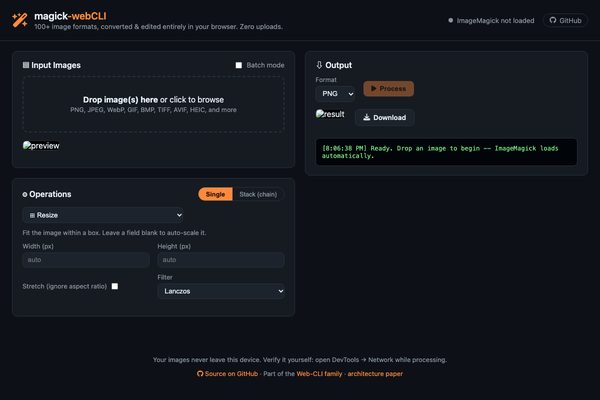
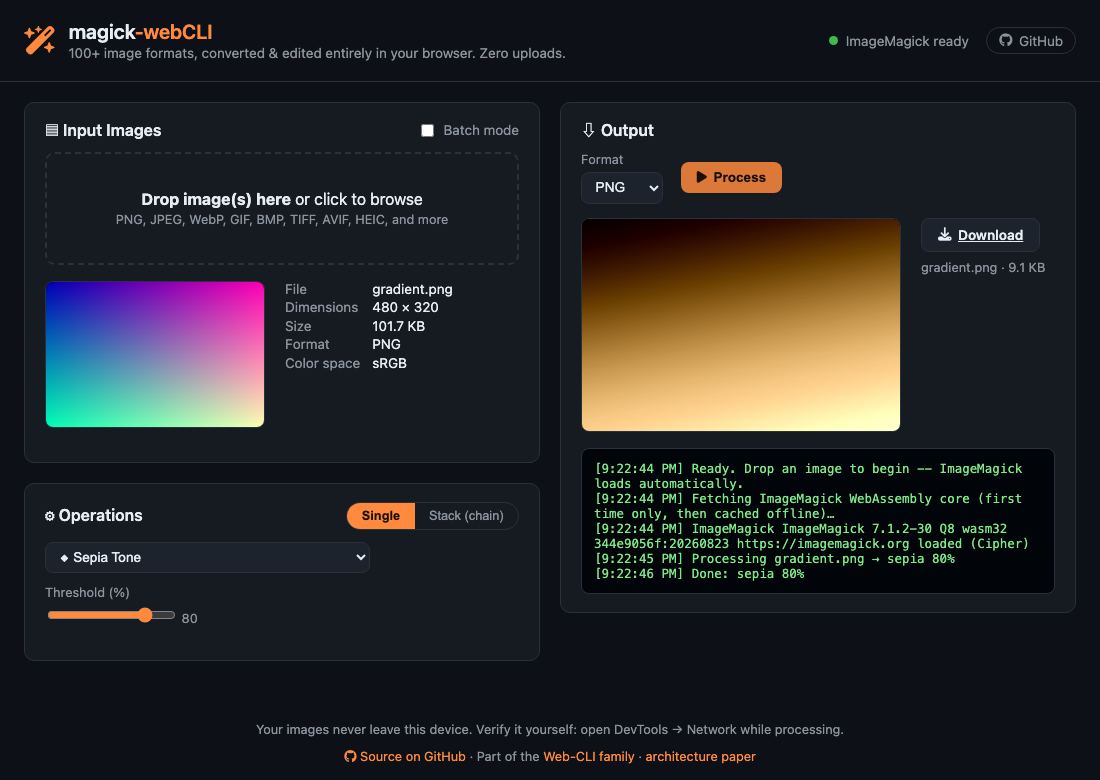
ImageMagick in a tab: sepia on a 480 by 320 PNG, nothing uploaded
magick-webCLI after a sepia run: the input gradient on the left, the sepia-toned output on the right, and the log line 'Done: sepia 80%'.
14 requests during page load and the run: 9 to magick.webcli.app, 3 to cdnjs.cloudflare.com (icon font), 2 to cdn.jsdelivr.net (ImageMagick WebAssembly). All were GETs and none carried a body, so the image was in no request.
Historical measurement, verified 2026-10-20, Chromium, magick.webcli.app; not a new audit of the current application. Open DevTools, Network, then drop an image and press Process. magick has no run= surface yet, so this is the interactive path; the cards say which tools can be driven from a URL today.
Stated once here, so it cannot drift across twelve READMEs. The left column is the claim; the right is what has been measured, and where nothing has been measured it says so.
Claim
Measured today
A persistent egress ledger that reads zero
12 of 12 made no non-GET request, sent no request body and made no request after the network was cut, from load to idle (2026-11-16). A representative operation is written for 0 of 12.
connect-src 'none' once loaded
0 of 12. 4 ship a Content-Security-Policy at all.
No credentials reachable from a worker
Not measured.
Refusals by name rather than silent approximation
Not measured across the family.
An open licence
11 of 12; the source of mocap is not public yet.
Operates offline once loaded
Not measured.
Two exceptions, and they are part of the claim. Loading is egress: fetching the WebAssembly core and any model is a request, always a GET with no body, and each tool's fetches in tools.json names what it fetches. Publishing is egress the user starts: hls and blog commit to a repository, and nothing is sent until you press Publish; hls says so in its Privacy and Egress section.
Each tool's origin was loaded in a fresh Chrome profile with the cache off, left idle for 8 s, then the network was cut and it was left idle for 5 s more; every request was logged from the DevTools protocol. Hosts other than the tool's own are what it fetched while loading, the first exception above. Non-GET and body bytes count anything that is not a bodiless GET. No tool was operated (that is 0 of 12 representative operations written), so this is load and idle, not use.
This page makes no request to any other host; CI loads it with a cold cache and fails on the first request that is not to its own origin, and the same check can be repeated in DevTools, Network, with Disable cache on.
Lab measurement of this page, median of 5: 0 JavaScript files, 3 requests, 148.7 KB transferred, first contentful paint 664 ms, largest contentful paint 664 ms, total blocking time 0 ms.
Method: blog-webCLI's cli/speed.mjs in headless Chrome: Slow 4G (1.6 Mbit/s down, 150 ms round trip), 4x CPU slowdown, a 390 px phone, a new browser profile for every run with the cache off, 5 runs, median reported; FCP and LCP from PerformanceObserver, total blocking time summed from long tasks after first paint; JavaScript counted from the network log. Lab data from one machine, served from 127.0.0.1, so the throttle supplies the latency but not DNS, TLS or distance; measured 2026-11-16.
The tools are meant to be driven by a URL and to return an artifact; 3 of 12 (rig, look, portrait) have the run= surface today. tools.json is the machine-readable index of this page: for each tool its origin, what it fetches and, where it has one, that surface (parameters, window.__webcli_result, test ids). Nothing here needs an account; the two tools that publish are the exception stated above.
The machine-readable index carries schema 3. A breaking change bumps that number; each entry declares its origin, state, inputs, outputs, egress, fetches and agent surface.
Processing happens on your device. Loading can fetch code, models and input URLs; publishing is an explicit action that sends content to your repository. Each card names its boundary. This index itself makes no third-party requests and runs no JavaScript.